



Published
What if we could answer one of medicine's pressing questions: are the medications pregnant women need safe for them and their babies — without asking them to bear the risk of finding out? That question sits at the heart of some of the most exciting women's health research funded by ARPA-H. In March, ARPA-humans and partners had the opportunity to see this work for themselves.
Program Manager Kate Arnold, M.D., MBA, visited The Charles Stark Draper Laboratory, Inc., one of ARPA-H's performers, to witness firsthand the science underway to change what's possible in maternal-fetal medicine. What we saw was as hopeful as it was humbling.
A gap that has gone on too long
Pregnant women and their healthcare providers are stuck between a rock and a hard place when making choices about managing chronic health conditions. To treat serious disorders like depression, seizures, or autoimmune disorders like Lupus or rheumatoid arthritis, doctors prescribe medications with limited safety data on the impact to the fetus. The potential risk to the baby is very difficult to quantify, but the alternative is to go without treatment, which carries its own risks entirely.
For almost four decades, physicians relied on U.S. Food and Drug Administration’s drug safety categories — a grading system that estimated relatively safe and known harmful categories to guide physician decisions. Those categories were retired in 2015 and providers are now left to make judgement calls without key information. The placenta is the most variable organ across species, so what we observe in animal studies does not always predict what happens in a human pregnancy. The risks of testing medication during pregnancy are prohibitively high, so we are left asking how can we provide patients and providers with better information about the safety of medication during pregnancy?
This is exactly the gap in research that ARPA-H is designed to help close.
Science you can hold in your hand
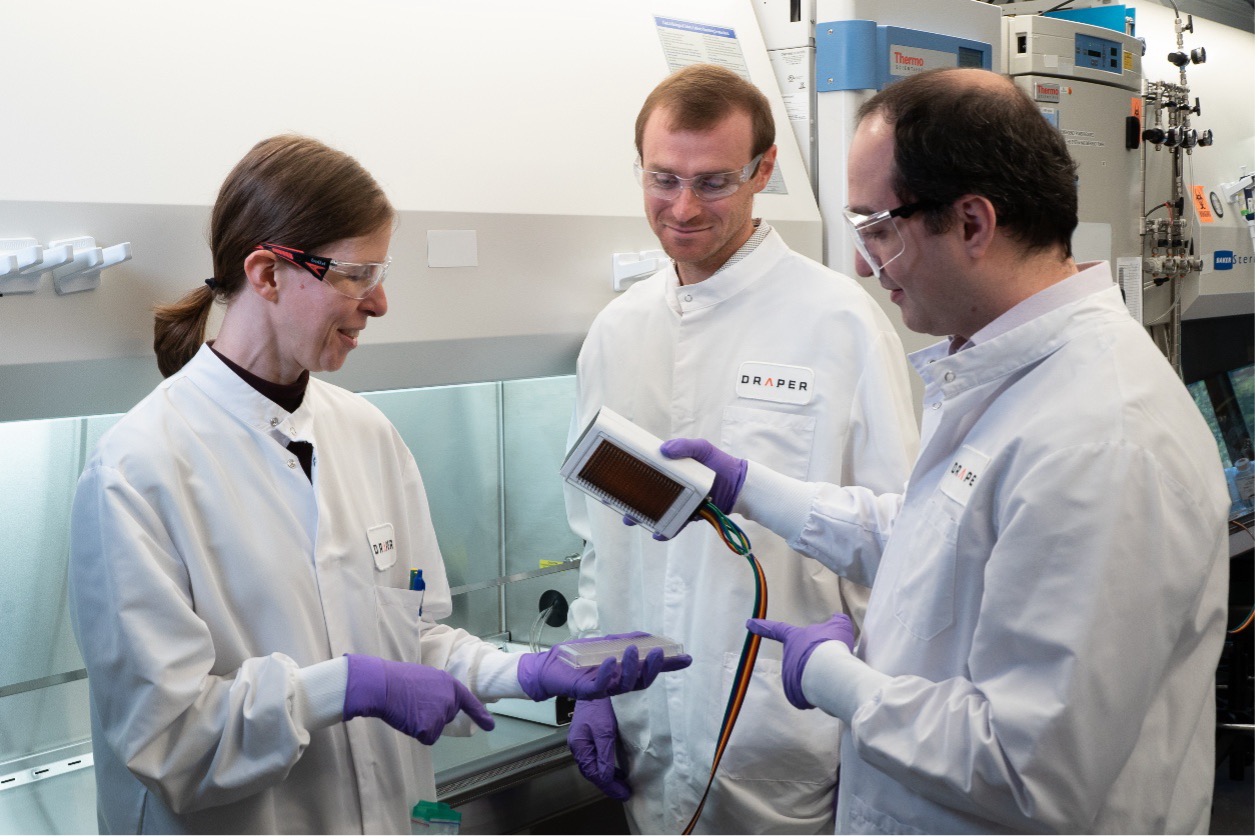
At Draper, a multidisciplinary team of bioengineers and researchers built something that looks deceptively simple: a small, programmable platform that you can hold in your palm and what it can do is extraordinary.
PREDICT96 is an organ-on-a-chip system that replicates both the placental barrier and fetal tissue, simultaneously. Using off-the-shelf cells to represent maternal and fetal tissue, a pump mimics circulation of blood flow (and medications) through the artificial “placental” barrier. A key data metric called transepithelial/endothelial electrical resistance (TEER) measures the health of the barrier in real time, providing researchers with meaningful, human-relevant data that animal models simply cannot replicate.
The first phase of this work is focused on modeling fetal placenta and heart tissue. The heart was a natural starting point because changes in cell function are observable, and the science of damage evaluation is well established. Current research is now examining how substances transfer across the artificial placental barrier, like caffeine or pain medications, and their effects on developing organs and tissues.
What's coming — and why it matters
Looking further ahead, the team envisions a future where this platform becomes a standard tool in drug development and eventually, maybe even a foundation for personalized care models. The long-term goal is a kind of digital twin of the maternal-fetal environment, tailored to a woman's individual placental function and her health conditions.
The next step is modeling fetal brain tissue within the PREDICT96 platform. ARPA-H's investment allows the Draper team to add modeling of fetal brain tissue to their project, enabled by additional fluidics technology already in development. For the women's health and research communities, this is significant.
Mood disorders are the number one cause of maternal mortality, and the medications used to treat them range from probably safe to possibly unsafe. Providers and families are again left to choose between the risk of fetal exposure to medication or the risk of untreated mental illness. Without data, they're navigating in the dark. This research in beginning to shed light on how we can make pregnancy safe for all.
Built to scale, built to last
The promise of this science only matters if it reaches the people who need it. Automation holds the key to scaling the platform and driving costs down, making it a viable and potentially preferable alternative to animal models in the drug development pipeline. Pharmaceutical companies and contract research organizations are natural partners in bringing this platform into broader use. The goal is not a narrow license or a single application. It is wide access: a new, rigorous standard for how pregnancy drug safety gets evaluated, developed, and communicated.
The ARPA-H team left Draper feeling energized and committed. The science is advancing. The investments are paying off. And the question we started with — what if we knew which drugs were safe to take during pregnancy without needing to test on pregnant women? — is closer to being answered than it has ever been.
This is the future of maternal medicine.
And it's being built with funding from ARPA-H.